

Air fryers typically use 1.2–1.8 kWh per hour, depending on wattage and cook time.
I’ve tested dozens of countertop cooks and studied appliance specs to explain air fryer electricity usage explained clearly. This guide breaks down how air fryers draw power, how to calculate real cost, what affects consumption, and practical tips I use at home to lower bills. Read on to understand air fryer electricity usage explained in simple steps and make smart choices for your kitchen and energy wallet.

How air fryers use electricity
Air fryer electricity usage explained starts with the heating element and fan. An air fryer uses an electric heating element to warm air. A high-speed fan moves hot air around food, creating crisping with less oil. Typical models list wattage between 800 and 1800 watts. Higher wattage means faster heat but not always higher total energy for shorter cooks.
Key components that use electricity:
- Heating element: produces most of the energy draw.
- Circulation fan: uses less power but supports even cooking.
- Control electronics and lights: small continuous draw during operation.
Understanding these parts helps you see why wattage and cooking time matter for air fryer electricity usage explained. Independent tests show that how long you cook and the temperature you set are the main drivers of total kWh used. Models with rapid preheat features may use more momentary power but reduce total cook time.
Typical energy use numbers and simple calculations
Air fryer electricity usage explained often starts with wattage and time. Use this formula to estimate kWh:
- kWh = (wattage in watts ÷ 1000) × hours used
Examples:
- A 1500-watt air fryer running for 0.5 hour uses 0.75 kWh.
- A 1200-watt air fryer running for 0.25 hour uses 0.3 kWh.
Convert kWh to cost:
- Cost = kWh × electricity rate (for example, $0.15 per kWh)
- 0.75 kWh × $0.15 = $0.1125 per cook
Real-life scenarios for air fryer electricity usage explained:
- Quick snack (10 minutes) on 1500 W: 0.25 kWh. At $0.15/kWh, cost ≈ $0.04.
- Dinner (30 minutes) on 1500 W: 0.75 kWh. Cost ≈ $0.11.
- Longer roast (60 minutes) on 1500 W: 1.5 kWh. Cost ≈ $0.23.
These simple numbers show you how to estimate your monthly use. Multiply per-cook cost by the number of uses per month to get household impact.

Factors that affect air fryer electricity usage explained
Several variables change how much electricity an air fryer uses. Understanding them helps lower bills.
Size and wattage
- Larger baskets and higher-wattage models heat faster but may draw more power at peak.
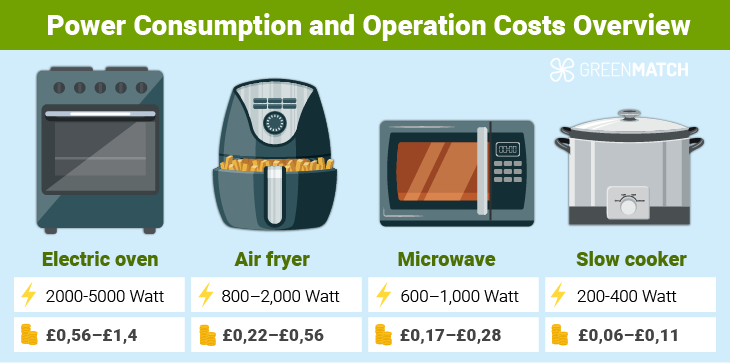
- Small models often use 800–1200 W; larger ones commonly use 1500–1800 W.
Temperature and cook time
- Higher temperatures use more energy per minute, but faster cooks may balance that.
- Preheating adds extra minutes; some recipes don’t need preheat.
Load and batch cooking
- Full baskets cook more efficiently per pound of food than single small items.
- Cooking multiple portions at once reduces per-serving energy use.
Insulation and design
- Models with better insulation and tighter lids lose less heat. Less heat loss means lower electricity for the same result.
User behavior
- Opening the drawer, adding cold food, or using long preheats increases total use. Small changes in habits alter air fryer electricity usage explained noticeably.
Air fryer vs conventional oven: energy efficiency comparison
Air fryer electricity usage explained often compares to ovens. Air fryers typically beat full-size ovens for small to medium batches.
Why air fryers are often more efficient
- Smaller cavity to heat. Less air equals faster heat-up.
- Faster circulation and concentrated heat reduce cook time.
- No need to preheat for many recipes, saving energy.
Comparison examples
- Baking a single chicken breast: Air fryer might use 0.5 kWh; oven could use 1.5 kWh for same result.
- Cooking a large tray for a family: Oven may be more efficient if it replaces multiple fryer batches.
Limitations
- For very large meals, a full oven can be more efficient per pound.
- Some oven technologies (convection ovens) narrow the gap between the two.
These points clarify how air fryer electricity usage explained compares to other appliances and when each appliance is best.

Practical tips to reduce electricity usage with your air fryer
Small changes cut energy and keep taste. Here are actionable tips I use personally.
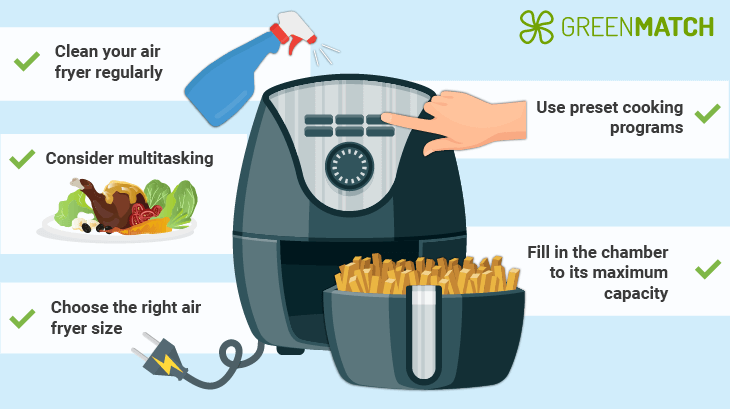
Preheat smart
- Skip preheat for many frozen foods and snacks.
- If preheat helps texture, limit it to 2–3 minutes.
Cook full loads
- Cook larger batches to lower kWh per serving.
- Reheat multiple items together when safe.
Choose the right size
- Use a smaller air fryer for single-person households.
- For families, a mid-size model avoids repeated batches.
Lower temperature slightly
- Reduce temperature by 10–20°F and add a couple minutes. Often no texture loss.
Use residual heat
- Turn off a minute or two early for small items; the fryer retains heat.
Maintenance matters
- Keep the basket and vents clean. Grease buildup reduces airflow and can increase cook time.
Personal experience
- I switched to batch cooking dinners in my air fryer twice a week. My monthly kitchen energy dropped noticeably. Simple steps like skipping preheat saved minutes every cook. Small habits compound into real savings when you track air fryer electricity usage explained.

Common mistakes and myths about air fryer electricity usage explained
There are misconceptions people believe about air fryer electricity usage explained. Let’s clear them up.
Myth: Higher wattage always means higher cost
- Not always. Higher wattage can reduce cook time and may lower total energy used for a set recipe.
Myth: Air fryers use no electricity when idle
- Controls and lights draw a small standby current. It’s tiny but exists.
Myth: Air fryers always beat ovens on efficiency
- For small meals, usually yes. For large trays, the oven can be more efficient per pound.
Mistake: Running multiple small batches instead of one big batch
- This multiplies heat-up cycles and increases total kWh. Combine batches where possible.
Understanding these corrects false expectations and helps you use your appliance efficiently while tracking air fryer electricity usage explained.

Frequently Asked Questions of air fryer electricity usage explained
How much electricity does a typical air fryer use per hour?
Most air fryers use between 0.8 and 1.8 kWh per hour depending on wattage. Shorter cook times often lower the real per-cook energy use.
Is an air fryer cheaper to run than a conventional oven?
For small to medium portions, yes. Air fryers heat faster and use less volume, which reduces kWh for many recipes.
Does preheating an air fryer waste electricity?
Preheating adds a small amount of energy. Skipping preheat for suitable foods often saves electricity without affecting results.
Will a higher-wattage air fryer raise my bill significantly?
A higher-wattage model may use more power per minute but can cut cook times. The total energy used depends on wattage multiplied by cook time.
Can using an air fryer reduce my monthly energy costs?
Yes, if you replace oven use for many small meals. Track usage and compare kWh to see real savings in your bill.
Conclusion
You now have a clear, practical view of air fryer electricity usage explained. Air fryers use predictable electricity based on wattage and time. Small habits—skipping unnecessary preheat, batching food, and choosing the right size—make a real difference. Try the simple experiments here to measure your unit’s kWh and then adjust your routine. Share your results or questions below, subscribe for more appliance tips, or leave a comment with your own energy-saving wins.