How Many Watts Does an Instant Pot Use? A Simple Guide for Home Cooks

If you use your Instant Pot often, it is natural to wonder what it is doing to your electric bill. You may also be asking because your kitchen outlet trips, you are choosing between a 3-quart, 6-quart, or 8-quart model, or you want to know whether pressure cooking is more efficient than using the stove.
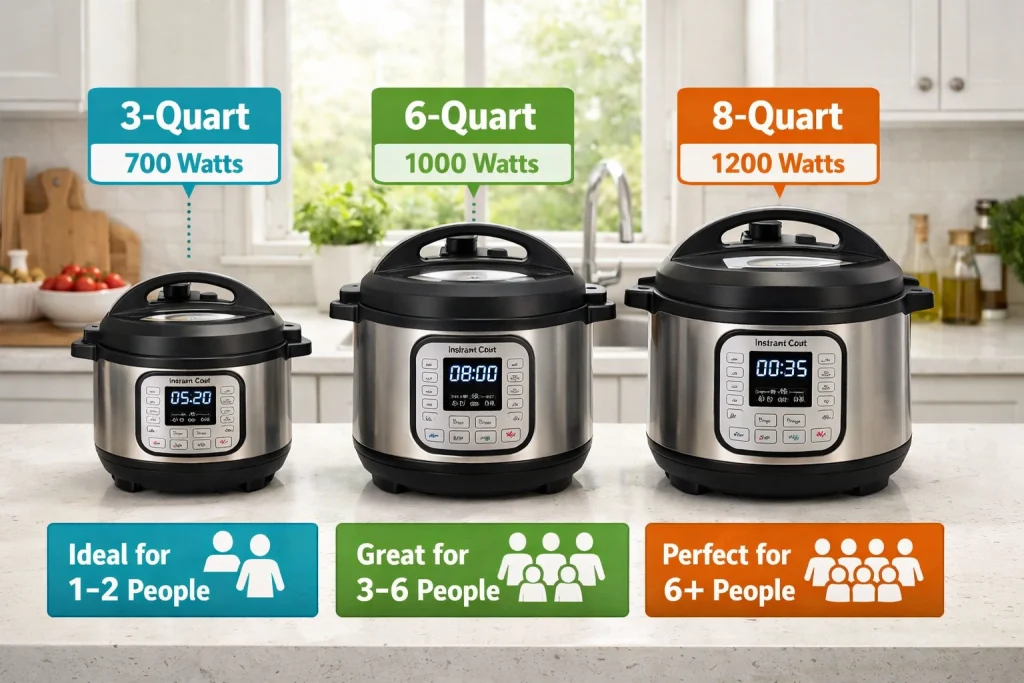
So, how many watts does an Instant Pot use? Most common Instant Pot models use between 700 and 1,200 watts, depending on size and model. A 6-quart Instant Pot, one of the most popular sizes for U.S. home cooks, usually uses about 1,000 watts.
This guide explains what that number means, how much electricity an Instant Pot may use during real cooking, how to estimate cost, and what safety signs to watch for.
Quick Answer
Most Instant Pots use 700 to 1,200 watts. A 3-quart model commonly uses about 700 watts, a 6-quart model about 1,000 watts, and an 8-quart model about 1,200 watts. The appliance does not usually pull full power the entire time because it cycles heat on and off during cooking.
What Does “Watts” Mean on an Instant Pot?
Watts measure how much electrical power an appliance can draw while operating. In simple kitchen terms, wattage tells you how strong the heating element is.
A higher-watt Instant Pot can usually heat a larger pot of food faster. That does not always mean it is better. It mostly means the appliance is designed for a larger cooking capacity.
For example:
- A small 3-quart Instant Pot needs less power because it heats a smaller inner pot.
- A 6-quart model needs more power because it handles family-size meals.
- An 8-quart model needs even more power because it heats more food and liquid.
The wattage printed on your Instant Pot is usually its maximum rated power, not the exact amount it uses every second.
Typical Instant Pot Wattage by Size
The exact wattage depends on the model, generation, and features. Always check the rating label on the appliance or the user manual for your specific unit. Instant Pot lists the 6-quart Duo as 1000 watts, 120 V, 60 Hz, and its product manuals are available through the official Instant Pot multi-cooker manuals page.
| Instant Pot Size | Common Wattage | Best For | Practical Note |
|---|---|---|---|
| 3-quart / Mini | About 700 watts | Singles, couples, sides, small kitchens | Lower power draw, but smaller capacity |
| 6-quart | About 1,000 watts | Most families, meal prep, everyday recipes | Best all-around size for most home cooks |
| 8-quart | About 1,200 watts | Larger families, batch cooking, big cuts of meat | Higher power draw and more counter space needed |
| Air fryer combo models | Often higher than standard pressure-only models | Crisping, roasting, pressure cooking | Check the exact model label before buying |
The popular Instant Pot Duo 6QT product page lists it as a 1000-watt appliance. That makes it similar in wattage to many countertop appliances, but it usually cooks in a smaller sealed chamber than an oven.
Does an Instant Pot Use Full Wattage the Whole Time?
No. This is one of the most important points.
Your Instant Pot may be rated at 1,000 watts, but that does not mean it uses 1,000 watts every minute from start to finish. It uses the most power when it is heating up. After it reaches pressure or temperature, the heating element cycles on and off to maintain heat.
Think of it like your oven. The oven heats strongly at first, then switches the heating element on and off to stay near the set temperature.
During Preheating
The Instant Pot uses more power during preheating because it must heat the inner pot, food, and liquid. This is when the heating element works hardest.
Preheating takes longer when:
- The pot is very full
- The food is frozen
- You use a lot of liquid
- The ingredients are dense, such as beans, meat, or soup
- The sealing ring is not seated properly
- The lid is not fully sealed
During Pressure Cooking
Once the Instant Pot reaches pressure, it does not need full power constantly. It only needs enough heat to maintain pressure.
That is why a 20-minute pressure cook does not always mean 20 minutes of full 1,000-watt electricity use. The actual draw rises and falls.
During Sauté Mode
Sauté mode can use a lot of power because the Instant Pot is trying to heat the bottom of the pot directly, similar to a stovetop pan.
If you sauté onions, brown meat, or reduce sauce for a long time, electricity use can increase. Sauté is useful, but it is not the lowest-power mode.
During Keep Warm
Keep Warm uses much less power than preheating or sautéing. Still, it uses electricity over time.
If you do not need Keep Warm, turn it off. This saves energy and also helps prevent some foods from drying out or getting mushy.
How to Estimate Instant Pot Electricity Cost
To estimate cost, use this simple formula:
Watts ÷ 1,000 × hours used × your electricity rate = estimated cost
The U.S. Department of Energy explains electricity use in kilowatt-hours, and the same basic idea applies here: watts become kilowatts when divided by 1,000. You can read more in this Department of Energy home energy guide.
Here is a simple example:
A 6-quart Instant Pot rated at 1,000 watts runs at full power for 30 minutes.
- 1,000 watts ÷ 1,000 = 1 kilowatt
- 30 minutes = 0.5 hours
- 1 kilowatt × 0.5 hours = 0.5 kWh
If your electricity rate is 18 cents per kWh:
- 0.5 kWh × $0.18 = $0.09
So, in this simplified example, the cooking session costs about 9 cents.
Real use may be lower because the Instant Pot does not pull full wattage the entire time.
Practical Cooking Cost Examples
These are rough examples for a 1,000-watt 6-quart Instant Pot. Your actual cost depends on your local electricity rate, recipe, cooking time, and how long the unit takes to pressurize.
| Cooking Task | Approximate Use Pattern | Estimated Energy Use | What It Means |
|---|---|---|---|
| Hard-boiled eggs | Short preheat + short cook | Low | Usually only a few cents |
| Rice | Moderate preheat + short cook | Low to moderate | Efficient for small batches |
| Soup or chili | Longer preheat + longer cook | Moderate | Still usually affordable |
| Frozen meat | Longer preheat | Moderate | Frozen food increases heating time |
| Long sautéing | Active heating | Higher | Use only as long as needed |
| Keep Warm for hours | Low draw but long time | Adds up slowly | Turn off if food is ready |
Is an Instant Pot Energy Efficient?
For many everyday meals, yes. An Instant Pot can be energy efficient because it cooks in a sealed inner pot and often reduces cooking time.
It may use less energy than a full-size oven for small or medium meals because it does not heat a large oven cavity. It can also be more efficient than simmering a pot on the stove for a long time, especially for beans, stew, stock, rice, and braised meat.
But it is not magic. Electricity use can rise when you:
- Use Sauté mode for a long time
- Leave Keep Warm on for many hours
- Cook very large batches
- Start with frozen ingredients
- Use an oversized model for tiny portions
Best rule: choose the Instant Pot size that fits the way you actually cook.
Does a Higher-Watt Instant Pot Cook Faster?
Sometimes, but not always in the way people expect.
A higher-watt model can heat a larger volume of food and liquid more effectively. That helps an 8-quart model handle bigger meals. But the cooking time in a recipe usually starts after pressure is reached.
So if a recipe says “pressure cook for 10 minutes,” that 10 minutes is the pressure-cooking time. It does not include the time needed to come to pressure.
A higher-watt model may reduce preheating time in some cases, but food size, liquid amount, starting temperature, and recipe type matter too.
Instant Pot Wattage by Cooking Mode
Different modes use electricity differently. The wattage label gives you the maximum rating, but cooking behavior changes by mode.
Pressure Cook
Pressure Cook usually uses high power at first, then cycles heat to maintain pressure. This is one of the most efficient uses of an Instant Pot for many meals.
Good examples include:
- Beans
- Rice
- Pot roast
- Chicken thighs
- Soup
- Lentils
- Stews
Sauté
Sauté uses direct heat from the bottom. It can run hot and use more active power.
Use it for quick browning or softening aromatics, but avoid letting it run longer than needed.
Slow Cook
Slow Cook uses lower heat over a longer time. Because it runs for hours, total electricity use depends on duration.
A slow-cooked meal may still be inexpensive, but an 8-hour cycle will naturally use more electricity than a short pressure-cooking cycle.
Yogurt
Yogurt mode uses controlled low heat. It may run for many hours, but it does not use full wattage continuously.
Keep Warm
Keep Warm is low-power compared with preheating. Still, it should not be treated as free. For best food quality, do not leave delicate foods warming longer than needed.
Safety: Outlet, Cord, and Breaker Considerations
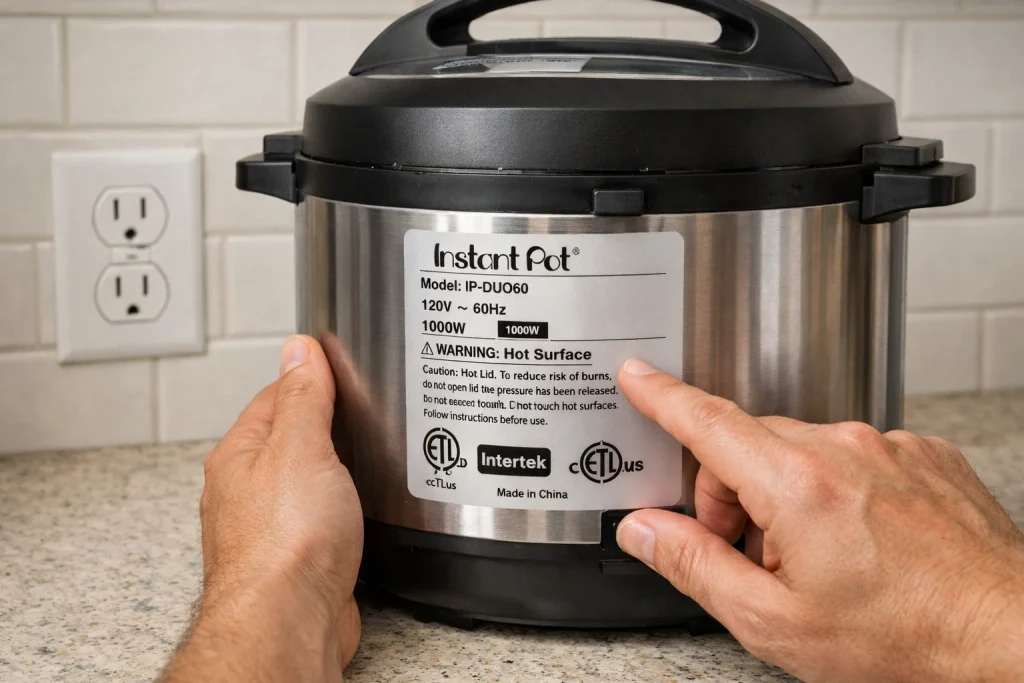
A 6-quart Instant Pot rated at 1,000 watts uses about 8.3 amps on a 120-volt U.S. outlet. An 8-quart 1,200-watt model uses about 10 amps.
That is normally fine for a standard kitchen circuit, but problems can happen if several high-watt appliances share the same circuit.
Be careful when running your Instant Pot at the same time as:
- Microwave
- Air fryer
- Toaster oven
- Electric kettle
- Coffee maker
- Countertop oven
If the breaker trips, move one appliance to another circuit or use them one at a time.
The U.S. Fire Administration advises unplugging small appliances when not in use and replacing appliances with cracked, damaged, or loose cords in its appliance and electrical fire safety guidance.
Important safety warning: Do not open the base, replace internal wiring, bypass safety sensors, or attempt electrical repairs yourself. An Instant Pot combines electricity, heat, and pressure. DIY internal repair can create shock, burn, or pressure hazards.
How to Lower Instant Pot Electricity Use
You do not need to obsess over every watt. Small habits make the biggest difference.
Try these practical steps:
- Use the right size model.
A 6-quart model is enough for most families. Do not buy an 8-quart model only because it sounds more powerful. - Avoid overfilling.
Overfilling slows preheating and can create pressure problems. - Use enough liquid, but not too much.
Extra liquid takes longer to heat. - Cut large food into smaller pieces.
Smaller pieces heat faster and cook more evenly. - Limit Sauté time.
Brown food, deglaze, then move on to pressure cooking. - Turn off Keep Warm when you do not need it.
This helps save electricity and protects food texture. - Keep the sealing ring in good shape.
A worn ring may slow pressurizing and waste heat. - Clean the heating area.
Make sure the outside of the inner pot is dry before placing it into the cooker base.
Does Wattage Matter When Buying an Instant Pot?
Yes, but it should not be your only buying factor.
A higher-watt model may heat more food, but it also costs more, takes more space, and may be unnecessary for smaller households.
Choose a 3-Quart Instant Pot If:
- You cook for one or two people
- You have a small kitchen
- You mostly make sides, rice, eggs, or small meals
- You want lower wattage and easy storage
Choose a 6-Quart Instant Pot If:
- You cook for two to five people
- You meal prep
- You want the most recipe flexibility
- You want the most common size for Instant Pot recipes
Choose an 8-Quart Instant Pot If:
- You cook for a large family
- You make big batches of soup, stock, or chili
- You often cook whole chickens or large cuts of meat
- You have enough counter and storage space
For most home cooks, the 6-quart model is the safest all-around choice. It balances wattage, capacity, cost, and recipe compatibility.
Expert Tip:
Before buying, check both the quart size and the wattage label. If your kitchen already struggles when the microwave and toaster run together, a larger 8-quart Instant Pot may be less convenient than a 6-quart model.
When to Contact Customer Support or Replace the Appliance
Most wattage questions are normal. But some signs point to a real appliance problem.
Contact Instant Pot customer support or consider replacement if you notice:
- The power cord is hot, cracked, melted, or discolored
- The plug feels loose in the outlet
- The cooker smells like burning plastic or electrical smoke
- The display flickers or shuts off during cooking
- The appliance repeatedly trips the breaker on different outlets
- The cooker takes much longer than usual to heat
- Steam leaks heavily around the lid even with a good sealing ring
- You hear buzzing, popping, or unusual electrical sounds
- The base has been dropped, flooded, or damaged
Do not keep using an Instant Pot with electrical warning signs. Unplug it, let it cool, and contact support.
Replacement may be smarter than repair if the unit is old, out of warranty, has multiple problems, or costs nearly as much to fix as a new model.
Common Mistakes Home Cooks Should Avoid
- Assuming 1,000 watts means 1,000 watts every second.
The heating element cycles during cooking. - Buying the biggest model only because it has more power.
Bigger is not always better for everyday meals. - Running too many countertop appliances on one circuit.
This can trip breakers and create frustration. - Using an extension cord.
High-watt cooking appliances should be plugged directly into a suitable outlet. - Leaving Keep Warm on all day.
It uses electricity and may hurt food quality. - Ignoring a damaged cord or hot plug.
Stop using the appliance if you see electrical damage. - Trying to repair internal electrical parts at home.
Pressure cookers are not safe DIY repair projects. - Forgetting to check the manual for your exact model.
Wattage varies by size and product line.
FAQs
How many watts does a 6-quart Instant Pot use?
A typical 6-quart Instant Pot uses about 1,000 watts. This is the rated maximum power, not necessarily the amount it uses every minute of cooking.
How many watts does an 8-quart Instant Pot use?
Many 8-quart Instant Pot models use about 1,200 watts. Because they are larger, they need more power to heat more food and liquid.
Does an Instant Pot use a lot of electricity?
Usually, no. Most Instant Pot meals cost only a few cents to cook, depending on your electricity rate and cooking time. Long Sauté, Slow Cook, or Keep Warm sessions use more energy.
Is a 700-watt Instant Pot enough?
Yes, if it is a small 3-quart model. It is good for rice, eggs, side dishes, and meals for one or two people. It may not be ideal for large family meals.
Can I use an Instant Pot on a generator?
Possibly, but the generator must handle the Instant Pot’s wattage plus extra starting and household loads. For a 1,000-watt Instant Pot, use a generator with enough safe capacity and follow the generator manual.
Why does my breaker trip when I use my Instant Pot?
The circuit may be overloaded. This often happens when an Instant Pot runs at the same time as a microwave, toaster oven, air fryer, or electric kettle. Try using one high-watt appliance at a time.
Should I unplug my Instant Pot after cooking?
Yes, it is a good habit. Unplug it after use, especially before cleaning or when leaving the kitchen for a long time. Let the appliance cool before handling removable parts.
Conclusion
So, how many watts does an Instant Pot use? Most models use between 700 and 1,200 watts, with the popular 6-quart size usually around 1,000 watts. But the real electricity cost depends on cooking time, mode, recipe, and how long the appliance takes to heat.
For most home cooks, the Instant Pot is an efficient and practical appliance. Choose the right size, avoid unnecessary Keep Warm time, use a safe outlet, and check your model label if you need exact wattage.
The best next step is simple: look at the rating label on your Instant Pot, match the size to your cooking needs, and use it with confidence.