How to Simmer in Instant Pot: A Simple Guide for Home Cooks

If you have ever tried to keep soup, sauce, chili, or stew gently bubbling in your Instant Pot, you may have wondered: Which button actually makes it simmer? Unlike a stovetop, an Instant Pot does not have a simple “low flame” setting. That can make simmering feel confusing at first.
The good news is that learning how to simmer in Instant Pot is easy once you know which function to use. In most cases, you will use the Sauté function on a lower heat setting, keep the lid off, and stir as needed. This guide explains exactly how to do it, when to simmer, what mistakes to avoid, and when your Instant Pot may not be the best tool for the job.
Quick Answer
To simmer in an Instant Pot, use the Sauté function on Low, Less, or a lower temperature setting, depending on your model. Keep the lid off, stir often, and adjust the heat if the food boils too hard. This works well for sauces, soups, stews, reductions, and thickening after pressure cooking.
What Does “Simmer” Mean in Everyday Cooking?
Simmering means cooking liquid gently below a full boil. You should see small bubbles rising slowly, not big rolling bubbles.
A simmer is useful when you want food to cook gently without drying out, burning, or breaking apart. It is common for:
- Soups
- Sauces
- Chili
- Stews
- Curry
- Beans
- Broth
- Pasta sauce
- Gravy
- Braised meats after pressure cooking
On a stovetop, simmering is simple because you lower the burner. In an Instant Pot, you choose the right cooking function and heat level instead.
Can You Simmer in an Instant Pot?
Yes, you can simmer in an Instant Pot. The easiest method is to use the Sauté function with the lid off.
Most Instant Pot models include a Sauté program that heats the inner pot from the bottom. Some models let you choose heat levels such as Less, Normal, and More, while newer models may show Low, High, or Custom temperature options. Instant Pot’s own multi-cooker product manuals are the best place to confirm the exact buttons for your specific model.
The key idea is simple:
Use Sauté for open-pot simmering. Use pressure cooking for sealed cooking.
Do not lock the pressure lid when you are trying to simmer. Simmering needs evaporation, stirring, and temperature control. A locked lid turns the process into pressure cooking, not simmering.
Best Instant Pot Setting for Simmering
For most home cooks, the best setting is:
Sauté → Less / Low
This gives you gentle heat for sauces, soups, and reductions. If your Instant Pot only has a basic Sauté button, press it again or use the Adjust button to cycle through heat levels if your model allows it.
Use “Less” or “Low” for Gentle Simmering
This is best for:
- Tomato sauce
- Creamy sauce
- Soup after pressure cooking
- Chili that needs thickening
- Gravy
- Curry
- Beans that are already cooked
This setting helps prevent scorching, especially with thick foods.
Use “Normal” for Faster Heating
Use Normal when your food is cold or watery and needs to come up to temperature first. Once you see steady bubbling, lower the heat if your model allows it.
This is helpful for:
- Brothy soups
- Thin sauces
- Large batches of stew
- Liquid-heavy dishes
Avoid “More” or “High” for Long Simmering
The More or High setting is better for browning meat, sautéing onions, or quickly boiling liquid. It can be too aggressive for simmering.
Use it only for a short time, then reduce the heat.
Important: Thick sauces can burn quickly on the bottom of the Instant Pot because the heating element is under the inner pot. Stir often.
How to Simmer in Instant Pot Step by Step
Follow these steps when you want a gentle simmer.
- Place the inner pot correctly.
Make sure the stainless steel inner pot is fully seated inside the cooker base. - Add your food or liquid.
Add soup, sauce, stew, broth, or cooked ingredients. Avoid filling too high because simmering can bubble and splatter. - Press Sauté.
Choose the Sauté function. If your model has heat levels, choose Less, Low, or the lowest setting. - Keep the lid off.
Do not pressure cook. Do not lock the lid. Simmering works best uncovered or with a loose glass lid. - Wait for gentle bubbles.
Look for small bubbles around the surface or edges. A strong rolling boil means the heat is too high. - Stir often.
Stir every few minutes, especially for tomato sauce, chili, gravy, beans, and cream-based foods. - Adjust the heat as needed.
If the food is barely moving, increase the heat briefly. If it bubbles too hard, lower the setting or cancel Sauté for a minute. - Cancel when done.
Press Cancel when your sauce is thick enough or your soup is ready.
What a Good Simmer Looks Like in an Instant Pot
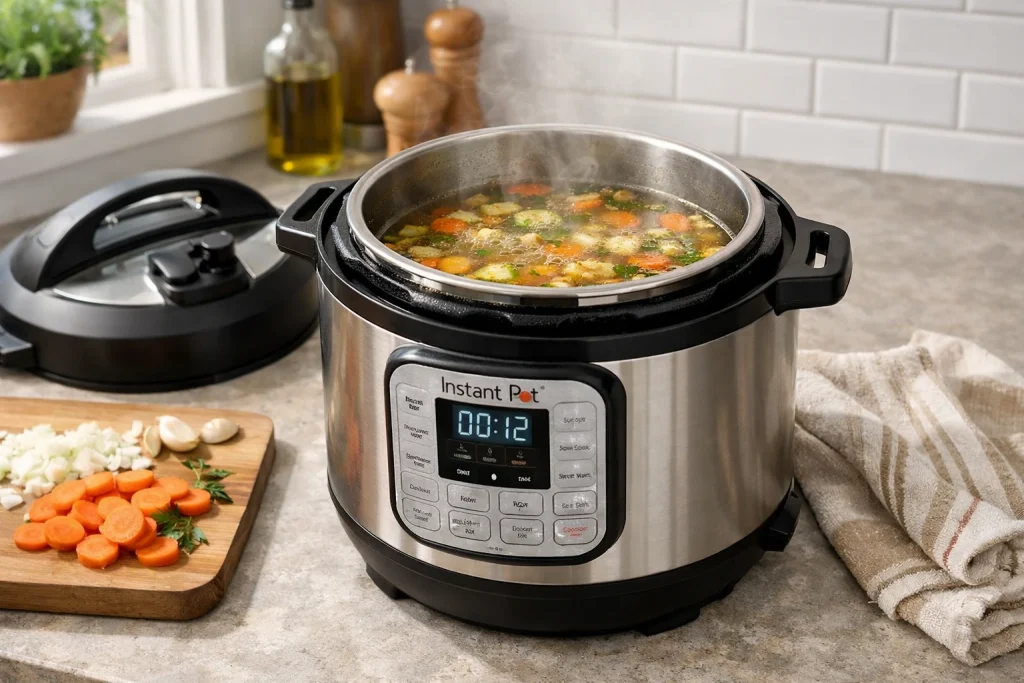
A proper simmer should look calm and controlled.
You should see:
- Small bubbles rising slowly
- Light steam
- Gentle movement in the liquid
- No violent splashing
- No burnt smell
- No thick layer sticking to the bottom
If your food is popping, splattering, or boiling hard, it is not simmering. It is boiling. Lower the heat or stir more often.
Simmering With the Lid Off vs. Lid On
For most simmering, keep the lid off.
Lid Off
Use the lid off when you want to:
- Thicken sauce
- Reduce extra liquid
- Stir often
- Prevent pressure buildup
- Watch the texture closely
This is the best method for tomato sauce, curry, chili, gravy, and soup.
Glass Lid or Loose Lid
A glass lid can help reduce splatter while still letting some steam escape. This is helpful for soups or sauces that bubble lightly.
Do not use the pressure lid locked in place for simmering. If you place the pressure lid on loosely, make sure it is not sealed and pressure is not building.
Pressure Lid Locked
A locked pressure lid is not for simmering. It traps steam and increases pressure. That changes the cooking method.
Never try to force open a pressure lid. If pressure has built up, follow your model’s normal pressure release instructions.
Best Foods to Simmer in an Instant Pot
The Instant Pot is very useful when you need to simmer after pressure cooking. For example, you may pressure cook chili, then simmer it uncovered for 10–15 minutes to thicken it.
Good foods for Instant Pot simmering include:
| Food | Best Setting | Why Simmer It? | Watch Out For |
|---|---|---|---|
| Tomato sauce | Sauté Less/Low | Thickens and deepens flavor | Can scorch if not stirred |
| Chili | Sauté Less/Low | Reduces watery texture | Beans may stick |
| Soup | Sauté Low/Normal | Keeps it hot and blends flavors | Can boil too hard |
| Curry | Sauté Less/Low | Thickens sauce | Coconut milk may separate |
| Gravy | Sauté Less/Low | Thickens with flour or cornstarch | Lumps form if not whisked |
| Stew | Sauté Low | Reduces broth after pressure cooking | Meat may break apart |
| Beans | Sauté Less/Low | Thickens bean liquid | Stir gently to avoid mashing |
How to Simmer Sauce in an Instant Pot
Sauce is one of the best reasons to use simmer mode.
Here is a simple method:
- Pressure cook or sauté your ingredients first.
- Press Cancel after pressure cooking is finished.
- Remove the lid safely.
- Press Sauté.
- Choose Less or Low.
- Stir the sauce.
- Let it bubble gently for 5–20 minutes.
- Stir every few minutes until it thickens.
For tomato sauce, keep the heat low. Tomato products can stick and trigger a burn warning if you later pressure cook again.
For cream sauce, simmer very gently. Dairy can curdle if overheated.
How to Simmer Soup in an Instant Pot
Soup is usually easier than sauce because it has more liquid.
Use Sauté on Low or Normal until you see gentle bubbles. Then lower the heat if needed.
Simmering soup is helpful when you want to:
- Add noodles after pressure cooking
- Cook leafy greens
- Warm frozen vegetables
- Reduce extra broth
- Add cream at the end
- Adjust seasoning
If you are adding cooked meat or leftovers, keep food safety in mind. The USDA explains that hot food should be held at 140°F or warmer to limit bacterial growth, and leftovers should be refrigerated within safe time limits according to its leftovers and food safety guidance.
How to Simmer After Pressure Cooking
This is one of the most practical Instant Pot skills.
Many recipes come out thinner after pressure cooking because very little liquid evaporates under pressure. Simmering after pressure cooking fixes that.
Use this method:
- Finish pressure cooking.
- Release pressure safely.
- Open the lid away from your face.
- Stir the food from the bottom.
- Press Sauté.
- Select Low or Less.
- Simmer uncovered until the texture improves.
This works especially well for chili, pulled meat sauce, stew, beans, curry, and pasta sauce.
How Long Should You Simmer in an Instant Pot?
It depends on the food and your goal.
- Thin soup: 5–10 minutes
- Chili: 10–20 minutes
- Tomato sauce: 15–30 minutes
- Curry: 5–15 minutes
- Gravy: 3–8 minutes
- Stew reduction: 10–20 minutes
- Beans: 10–15 minutes
Use time as a guide, not a rule. The real goal is texture.
Stop simmering when the food tastes right and looks right.
Can You Use Slow Cook Instead of Sauté to Simmer?
Sometimes, but it is not the best choice for a quick simmer.
The Slow Cook function uses gentler heat over a longer time. It is better when you want food to cook slowly for hours, not when you want to reduce sauce quickly.
Use Sauté when you want:
- Visible bubbling
- Fast thickening
- Liquid reduction
- Open-lid cooking
- A stovetop-like effect
Use Slow Cook when you want:
- Long, gentle cooking
- Less stirring
- A slow cooker-style meal
- Food held at a lower, steady heat
If your recipe says “bring to a simmer,” Sauté is usually the better Instant Pot choice.
Expert Tip
Expert Tip:
When simmering thick foods like chili, tomato sauce, or curry, stir in a “figure-eight” pattern across the bottom of the pot. This helps prevent hidden hot spots and keeps food from sticking where the heating element is strongest.
Safety Tips for Simmering in an Instant Pot
Simmering is simple, but the Instant Pot is still an electrical appliance that produces heat and steam.
Follow these safety habits:
- Keep the cooker on a flat, dry counter.
- Do not let the cord hang over the edge.
- Keep the base away from water.
- Do not fill the pot too high.
- Use oven mitts if the pot or steam is hot.
- Do not lock the pressure lid for open simmering.
- Do not leave thick sauces unattended for long.
- Unplug the appliance after cooking.
The U.S. Fire Administration recommends unplugging small appliances when they are not in use and keeping burnable items away from heat sources in its appliance and electrical fire safety guidance.
Also check the cord regularly. If it is cracked, frayed, melted, or loose, stop using the appliance.
Why Your Instant Pot Simmer Is Too Hot
If your food keeps boiling hard, the setting is probably too high.
Try these fixes:
- Switch from Normal to Less or Low.
- Press Cancel for 1–2 minutes, then restart Sauté on a lower setting.
- Stir more often.
- Add a small splash of broth or water if the food is too thick.
- Use a glass lid to reduce splatter, but do not seal pressure.
- Move very delicate sauces to the stovetop if needed.
Some Instant Pot models heat more aggressively than others. This is normal. Smaller amounts of food also heat faster, so a half cup of sauce may boil much faster than a full pot of soup.
Why Your Instant Pot Is Not Simmering
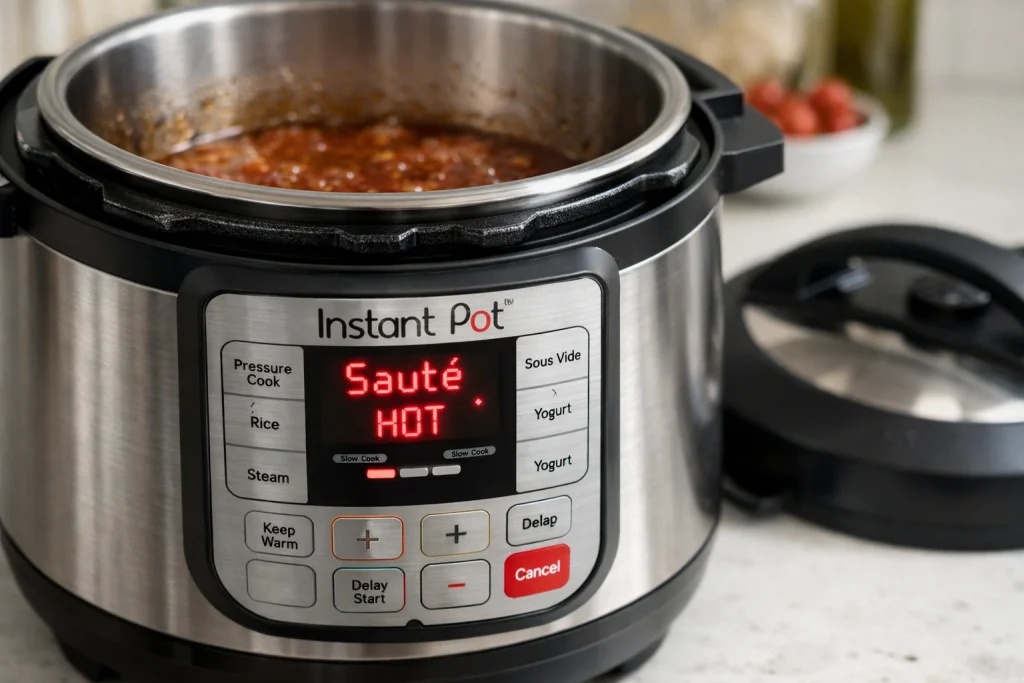
If nothing seems to happen, check these common causes:
- The Sauté function was not started.
- The cooker is still preheating.
- The food is very cold.
- There is too much liquid.
- The inner pot is not seated correctly.
- The outlet is not working.
- The heat level is too low for the amount of food.
Give the pot a few minutes to heat. If the food is refrigerator-cold, it may take longer.
If the display, buttons, or heating element seems faulty, stop using it and check the manual or manufacturer support.
Common Mistakes Home Cooks Should Avoid
- Using the pressure lid locked in place.
This creates pressure cooking, not simmering. - Choosing High or More for thick sauce.
High heat can scorch tomato sauce, chili, gravy, and curry. - Walking away too long.
A simmer still needs attention, especially with thick foods. - Not scraping the bottom after pressure cooking.
Browned bits and starch can stick and burn during simmering. - Adding dairy too early.
Milk, cream, and cheese can separate if boiled hard. - Overfilling the pot.
Bubbling food can splatter and make stirring difficult. - Ignoring burnt smells.
If food smells burnt, press Cancel and check the bottom right away. - Using metal tools roughly.
Stainless steel inner pots are durable, but aggressive scraping can still damage surfaces over time.
Simmering vs. Boiling vs. Keep Warm
These settings can feel similar, but they are not the same.
| Method | What It Does | Best For | Not Best For |
|---|---|---|---|
| Simmer | Gentle bubbles below a full boil | Sauces, soups, stews | Fast pasta boiling |
| Boil | Strong rolling bubbles | Water, quick reduction | Cream sauces, delicate foods |
| Keep Warm | Holds cooked food warm | Serving, short holding | Cooking raw food or reducing sauce |
Keep Warm is not a true simmer. It can hold food warm after cooking, but it usually will not reduce liquid or thicken sauce effectively.
For food safety, hot foods should stay hot enough during holding. The USDA’s danger zone guidance explains that bacteria grow quickly between 40°F and 140°F, so cooked food should not sit at unsafe temperatures for long periods.
Cost, Quality, and Product-Choice Considerations
If you simmer often, your Instant Pot model matters.
Basic models can still simmer well, but newer or higher-end models may offer better temperature control. Some have clearer Low, High, or Custom settings. Others use Less, Normal, and More.
When choosing or upgrading an Instant Pot, consider:
- Temperature control: Better control makes simmering easier.
- Inner pot quality: Stainless steel is durable and good for sauces, but food can stick.
- Size: A 6-quart model is practical for most families. An 8-quart model is better for large batches.
- Display clarity: Clear buttons reduce mistakes.
- Replacement parts: Sealing rings, lids, and inner pots should be easy to find.
- Safety features: Look for a model with pressure protection and clear release controls.
If you mostly cook soups, chili, beans, and stews, an Instant Pot is a strong choice. If you mostly make delicate sauces, candy, or temperature-sensitive reductions, the stovetop may still give you more control.
When to Use the Stovetop Instead
The Instant Pot is convenient, but it is not always the perfect simmering tool.
Use the stovetop instead when you need:
- Very precise heat control
- A wide pan for faster evaporation
- Constant whisking
- Delicate butter sauces
- Candy making
- Small amounts of sauce
- Very fast reduction
The Instant Pot has a narrow, deep pot. That means less surface area for evaporation compared with a wide skillet or saucepan. So reducing sauce can take longer.
Cleaning After Simmering
After simmering, clean the pot before food dries onto the surface.
- Press Cancel and unplug the cooker.
- Let the inner pot cool slightly.
- Remove the inner pot from the base.
- Wash with warm soapy water.
- Soak stuck-on food for 10–20 minutes.
- Use a non-abrasive sponge.
- Dry fully before placing it back in the cooker base.
Never pour water into the Instant Pot base. Only the removable inner pot should be washed.
If you notice strong food smells in the sealing ring, remove and wash the ring separately. The sealing ring can hold odors from chili, curry, garlic, and tomato sauce.
When to Contact Customer Support or Replace the Appliance
Contact Instant Pot customer support or consider replacing the appliance if you notice serious performance or safety issues.
Watch for these warning signs:
| Warning Sign | What It May Mean | What to Do |
|---|---|---|
| Sauté does not heat at all | Heating element or control issue | Contact support |
| Food burns instantly on low heat | Sensor or heating problem | Stop using and troubleshoot |
| Display flickers or shuts off | Electrical fault | Unplug and contact support |
| Cord is frayed or melted | Fire/electrical risk | Do not use |
| Steam leaks during pressure cooking | Lid, ring, or valve issue | Inspect parts and contact support |
| Error codes appear repeatedly | Sensor or system issue | Check manual and support |
| Base got wet inside | Electrical hazard | Stop using immediately |
Do not open the cooker base or attempt electrical repairs at home. The Instant Pot contains electrical components and heat sensors. DIY repair can create shock, fire, or pressure safety risks.
For simple parts, like sealing rings or inner pots, replacement may be enough. For electrical issues, repeated error codes, damaged cords, or pressure problems, manufacturer support or appliance replacement is the safer choice.
FAQs
Can you simmer in an Instant Pot without the lid?
Yes. In most cases, simmering works best with the lid off. Use the Sauté function on Low or Less, stir often, and watch for gentle bubbles.
What button do I press to simmer in an Instant Pot?
Press Sauté. Then choose Less, Low, or the lowest available heat setting on your model. Keep the lid off while simmering.
Is Sauté the same as simmer on an Instant Pot?
Not exactly. Sauté is the function that gives open-pot heat. You create a simmer by using Sauté on a lower setting and controlling the bubbling with stirring and heat adjustment.
Can I simmer soup in an Instant Pot?
Yes. Use Sauté on Low or Normal until the soup gently bubbles. Stir occasionally and lower the heat if it starts boiling too hard.
Can I simmer with the pressure lid on?
Do not lock the pressure lid when simmering. A locked lid can build pressure, which changes the cooking method. Simmering should be done uncovered or with a loose glass lid.
Why does my Instant Pot burn food when simmering?
The heat comes from the bottom, so thick foods can stick if the setting is too high or you do not stir enough. Use Low or Less, stir often, and add a splash of liquid if needed.
Can I reduce sauce in an Instant Pot?
Yes. Use Sauté with the lid off and simmer until extra liquid evaporates. It may take longer than a wide stovetop pan because the Instant Pot has less surface area.
Conclusion
Learning how to simmer in Instant Pot makes the appliance much more useful for everyday cooking. The basic method is simple: use Sauté, choose Low or Less, keep the lid off, and stir often.
Use simmering to thicken chili, reduce sauce, finish soup, improve curry texture, or adjust a recipe after pressure cooking. Watch the bubbles, not just the timer. Small gentle bubbles mean you are simmering; big rolling bubbles mean the heat is too high.
For most home cooks, the Instant Pot is a convenient simmering tool when used carefully. Start with low heat, stay nearby, and keep safety in mind. Then use your Instant Pot with more confidence the next time a recipe says, “bring to a simmer.”